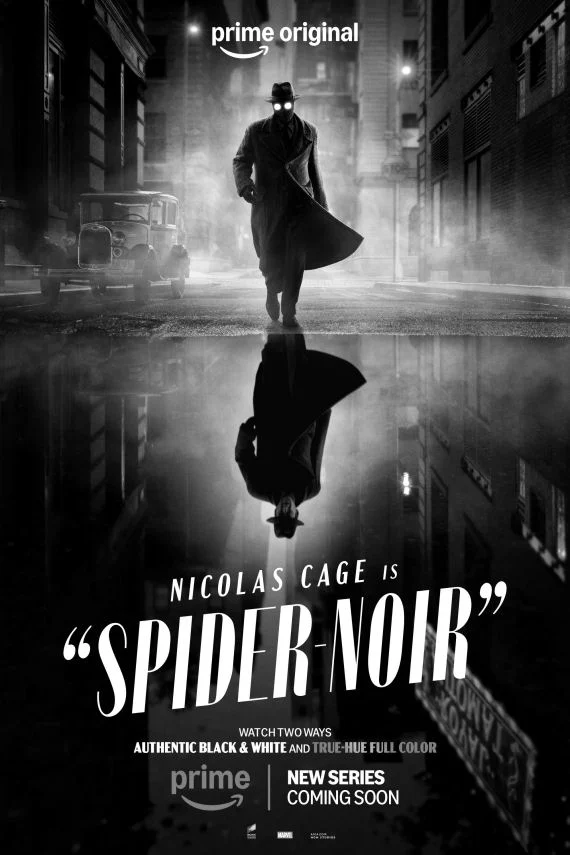
One problem with not reading comics for over 20 years is that you lose track of all the changes. When you’re young you figure your favourite comic hero will always be there, always the same. But that doesn’t happen anymore. Case in point—some time in the last 30 years when I wasn’t really paying attention, Marvel started having adventures in other dimensions, on various Earths, and one such adventure was called “Spider-Man Noir,” featuring Peter Parker as a totally different kind of Spider-Man. Then some bigwig had a brilliant idea and said “Let’s bring this one to TV, but let’s change it a bunch!” And Spider-Noir was born (Figure 1).
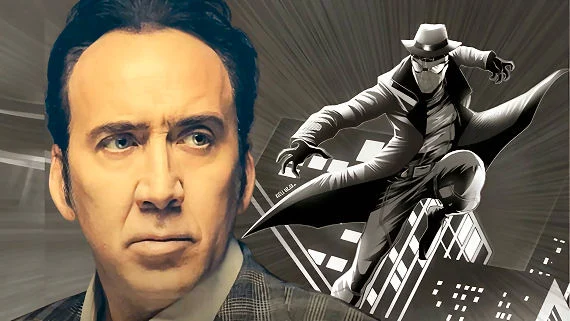
Now, everyone knows Nic (Nicholas) Cage; his real last name is Coppola and he’s something like director Francis Ford Coppola’s nephew (but he didn’t want to trade on that name, so he called himself Cage. I dunno why that name, but you can probably look it up). And for decades, Nic has wanted to play Superman in a movie, but never got the chance, even though he screen-tested for the role. (He did, however, thanks to AI, briefly play the role in the recent Flash movie, thanks to that screen test). Now, I don’t know if he really wanted to play Spidey the way he wanted to play Supes, but somehow he got matched with the iconic Marvel role, but not quite as the Marvel comics would have it (Figure 2; Figure 2 shows Nic as Nic, and Spider-Man Noir, the Marvel version.)
This Spider (not called Spider-Man) is not Peter Parker, and he doesn’t have all of Spidey’s powers; as far as I can tell, all he has is web spinnerets in this forearms, the ability to stick to things, and Peter’s “Spidey sense.” No proportional spider strength, no accelerated healing. And his webs are intermittent; they’re the product of gene therapy due to a DNA-infused fusion of man and spider (a chimera, if you will) thanks to German experimentation on prisoners in World War 1 Occupied France. And it’s set in the Prohibition era, which ranged from somewhere around 1920 to 1933, probably in Manhattan. And when this Spider gets hit, he gets bruised, or cut, or shot, depending on the foe!
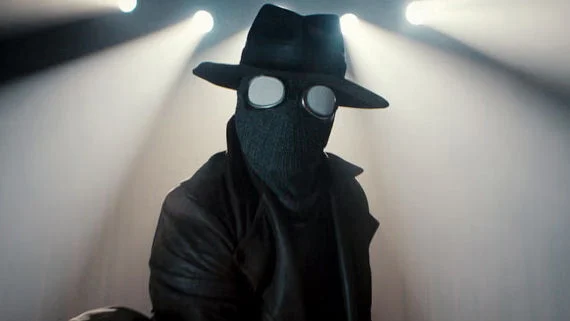
The main characters in this series have names that will be familiar to most followers of the Marvel Spiderverse. Cage plays Ben Reilly (not the Reilly from Earth-616, who was a Peter Parker clone), who is a private eye, but secretly plays The Spider, a superhero (apparently the only superhero in this particular universe) who for years was Manhattan’s guardian angel. He ceased being the Spider when the love of his life (Ruby, played by Amanda Schull) was killed by Silvermane (Brendan Gleeson), the Crime Boss of New York, five years before this series takes place.
So Ben is making his living taking photos of straying wives, finding cheque bouncers, and all the petty little jobs that a down-at-the-heels PI (Private Investigator) does to pay the rent. Unfortunately, he hasn’t paid the rent in a couple of months, and he’s about to lose the office and his secretary, Janet (Karen Rodriguez). Of course, he’s not alone in being down in the dumps; his friend and confidant Robbie Robertson (Lamorne Morris), has himself been fired from his job at the Daily Bugle due to upsetting the wrong people in power.
Although the “noir” part of this is stellar, the series is not without problems: the pacing varies often from slow to glacial. They take way too many episodes to give Ben’s backstory, which I feel is important to the viewer. Although the series is set before the end of Prohibition, the music often is wrong for the era (occasionally the jazz is a bit more modern than that, and the song “Sway” wasn’t released until 1954), and there are a few small anachronisms that break the era—but overall, it works as 1930s Noir. In particular, Ben’s way of speaking imitates screen gangsters like James Cagney. (I haven’t looked at the colour version, because that wouldn’t match up with “Noir.”)
Anyone familiar, by the way, with the name Robbie Robertson will remember that the original Robbie was an editor (African-American) at the Daily Bugle. Anyway, the character development is kind of slow in this series, though if it gets a second season (which I think may be in doubt), I’m sure they’ll do a better job next season. Standout actors (besides, of course, Nic himself) include Brendan Gleeson as Silvermane; Karen Rodriguez as Janet; Lamorne Morris as Robertson; Jack Huston as Flint Marko (another nod to the Peter Parker Spider-Man; Marko is The Sandman); Li Jun Li as torch singer Cat Hardy; Abraham Popoola as Lonnie Lincoln; Lukas Haas as Winston; and Andrew Lewis Caldwell as Dirk Leyden (an in-joke for people who know electricity).
Although some might find this show a bit slow, both I and my wife (the Beautiful and Talented Lynne Taylor Fahnestalk) enjoyed it very much as a modern bit of noir and a nod to the classic films of the ‘30s and ‘40s. I definitely hope that the PTB (Powers That Be) will let it continue. Let’s face it—nobody chews scenery like Nicholas Cage when he’s set loose—he’s quite entertaining!
NOTE: This column is in no way written, edited, proofed or composed by AI, though some of my photo editing software uses it in some capacity. This is a human column and will remain so.
I’m on Facebook (or you could email me stevefah at hotmail dot com), so if you liked it, let me know—or if you have any comments at all! My opinion is, as always, my own, and doesn’t necessarily reflect the views of Amazing Stories or its owner, editor, publisher or other columnists. See you next time!